
This DIY winnower design still works — and if you like building your own gear, have at it. Since this was published way back in 2011, we've developed two purpose-built winnowers that use the same Champion Juicer and Shop-Vac approach but with proper separation chambers and airflow tuning built in.
The Sylph Winnower is designed for home chocolate makers doing small batches. If you're scaling up to commercial level production work, the Flux Commercial Winnower is built for that — stainless steel, 50 lb hopper, 120–140 lb/hour throughput. Now back to the post.
Okay, for those of you completely chomping at the bit, here is the first draft of an easy to build and operate Do It Yourself (DIY) winnower. It's made from 2" and 3" PVC fittings and pipe, a Champion Juicer and a common Shop-Vac. You will need to work out a support structure for it if you want to build one now, but that too will come along at some point in the next month or so. It will handle both roasted and raw cocoa beans. Roasted behave much better, but in either case, the better the bean preparation, the better the separation. It will produce 1 lbs of nibs in just over a minute and will average 77-79% recovery when 'tuned' properly.
I have not yet detailed every last bit of information on how to assemble it, but I wanted to get it out there. I will be talking at length as to how and why it works, how the inspiration came (it's from 15 years as a chemist working with quadupole and ion trap mass spectrometers - how's that for a small tease?).There are virtually endless configurations that can work - and of course virtually endless variations that will not work. If you can build it exactly as is, perfect. If you feel you must modify something, PLEASE try not to change the pieces in yellow. Their dimensions, sizes, lengths, configurations, etc WORK. But as you will notice, there are LOTS of places you can customize for your needs.That's it for now - here it is:And here are the more detailed plans.
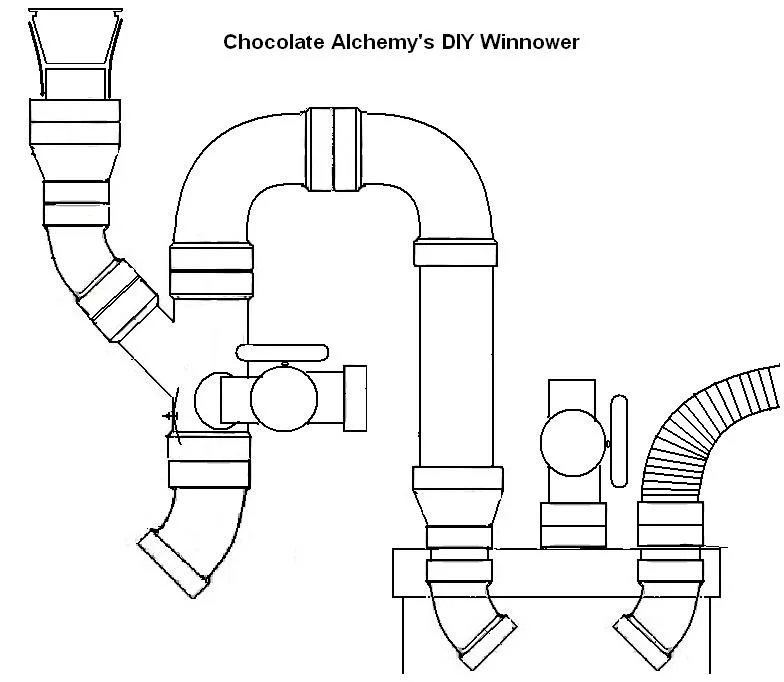
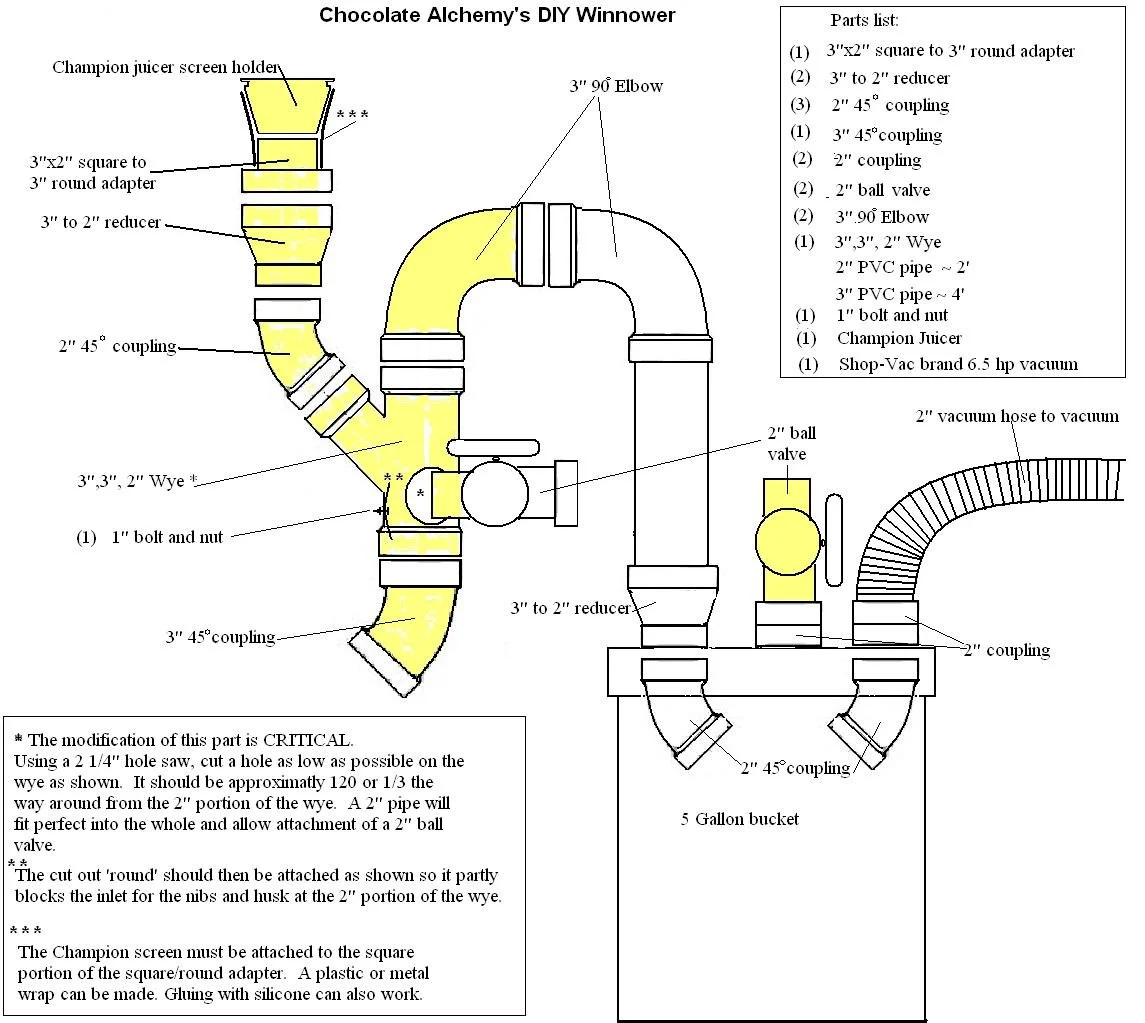
Feel free of course to e-mail me if you have questions. If you build it, you will have to 'tune it' by adjusting the two valves to regulate the air flows. Off hand, as an estimate, the valve on the left can be all the way open for raw nibs, and about 1/3 close for roasted nibs. The valve on the right is adjusted to regulate the total flow and is closed until husk stops falling out of the nib exit. Again, I'll detail tuning in greater depth, and email if you want more information now. Finally, and please pardon my soapbox (stepping up as we speak), but PLEASE don't ask me why I didn't design it this way or that way. I can't answer that negative question. The base answer is I've designed and built something that works with parts that are off the shelf, and/or very simple to make if you have a mind to. And I don't fix what isn't broken. Is it perfect? No. Is it $35,000? No. Is it $5,000? No. Am I a little defensive - yeah, maybe a little. In almost every case the answer as to why this or that isn't in there is cost and ease of making it. This is an elegant, simple design that works. Are there places for improvement? Yep, and they will most likely add cost because they will be more complex. (stepping down). But right now for about $50 in PVC, plus a Champion (which you may well have), and a Shop-Vac (again that you may have), plus a couple hours time, you can have an automated working winnower. That all said, feel free to ask why I designed it a certain way (do you note that difference?). I am more than happy to discuss why it is designed as it is and how it works.
