
Ask the Alchemist #342 Citrus Ruby Chocolate
Could you use lemon/ lime juice instead of citric acid? any idea of quantities? I don’t like how citric acid is made.
I can’t believe I’ve never thought of this. This is why I love questions. It is so easy to get stuck in your own head and miss the obvious.
What is Ruby Chocolate?
There are various compounds in raw cocoa, with the class of ones responsible for Ruby’s color, called catechins. According to the patent (yep, there is a patent even though it is widely known know how to make it), the level of polyphenols in the nibs should comprise at least 20 mg/g and most preferably 40 to 60 mg/g polyphenols, expressed as epicatechin equivalents. When the nibs are acidified with either citric acid or phosphoric acid the nibs turn either a red or purple hue. (we have both - links).
The other important thing about Ruby is that in order to hit the level of polyphenols needed for the color change the cocoa beans can’t be fermented. These are refereed to as Lavados or washed beans.
Finally, Ruby was officially designated as the 4th kind of chocolate along with Dark, Milk and White, back in 2017. Many people, including myself, don’t agree it is new - it is just a variation of milk chocolate where the nibs have been turned from brown to red/purple.
Ruby Chocolate Recipe and the role of citric acid
80 g roasted or unroasted Oaxaca Lavados
8 g citric acid dissolved in 20 g water
320 g cocoa butter
300 g milk powder
295 g sugar
As you can see, 10% citric acid (8/80) works a treat to cause the color change chemical reaction.
So the question then is, how much citric acid is in lemon or lime juice and is it feasible to add. Consulting the Oracle G, I found that the concentration varies in the range of 4.2-5.0 %. Not to bore you with the maths, that means about 46 grams per liter or 4.6 grams per 100 ml. Crunching through the calculations you really don’t need to concern yourself with it means to get 8 g of citric acid for the recipe above we would need to use about 175 ml of juice. Since there is only 80 grams of nibs I was immediately skeptical this would work. From previous tests I’ve done I’ve found that cocoa nibs can only absorb a little over half their weight in water, so over twice their weight is out of the question.
What to do, what to do? As a good scientist, the obvious answer is #FAFO
#FAFO(ing)

In this case, I threw caution to the wind and mixed 80 g of nibs with 100 g of mixed lemon and lime juice.....and I got.... wet nibs. Nothing else happened.
Every time in the past that I’ve added a citric acid solution to Ruby nibs the color change was nearly instantaneous. Regardless, and since I was already committed and had nothing to lose I left the limed nibs over night and decided to check on them the next day. To my surprise and delight I came in and found this.
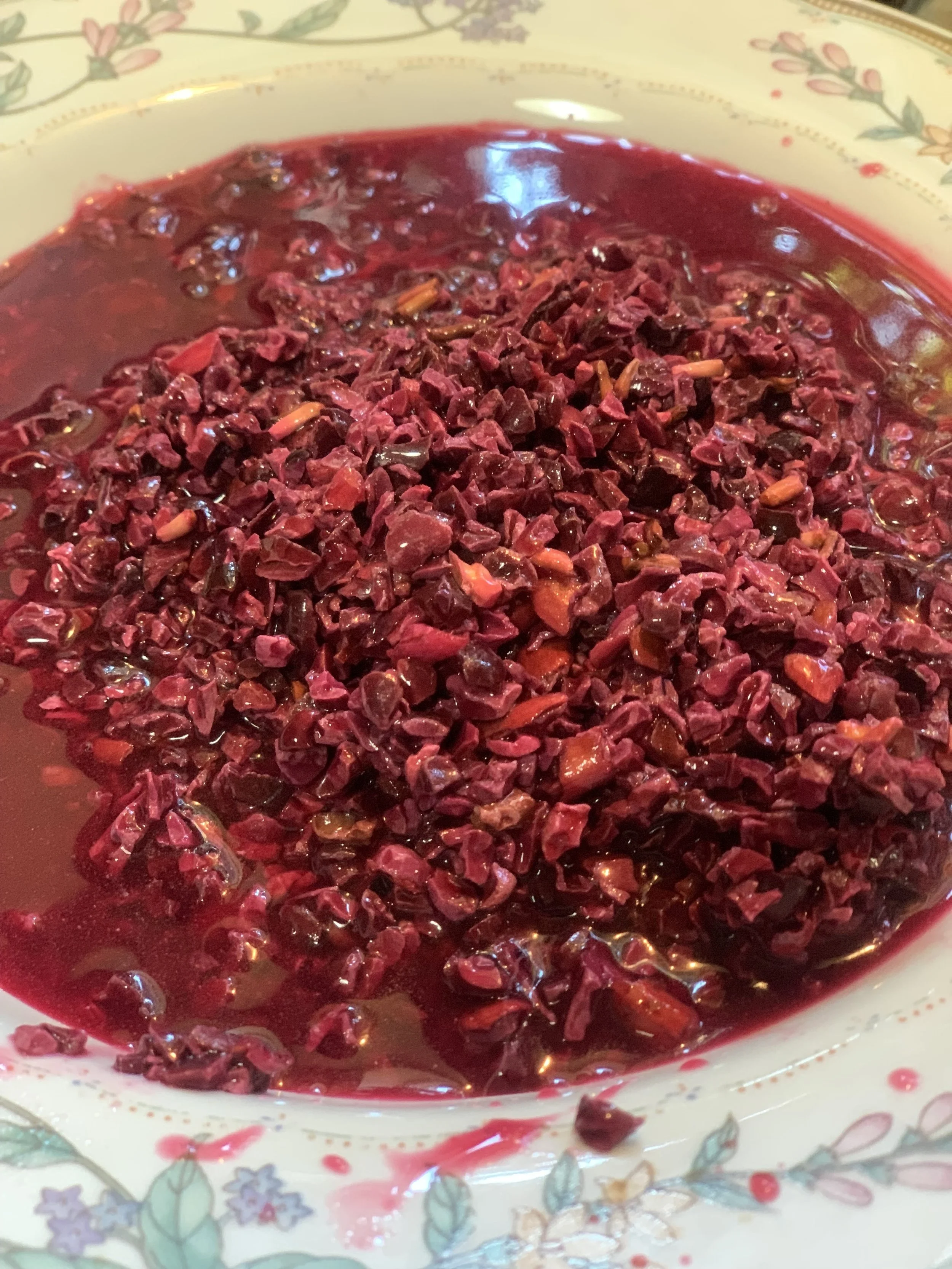
This is why we #FAFO as theory is only a theory until proven or disproven. All the calculations said that more citric acid was needed but the actual testing proved this inaccurate. I proceeded to drain the nibs and then dry them in my dehydrator at 105 F for about 6 hours.
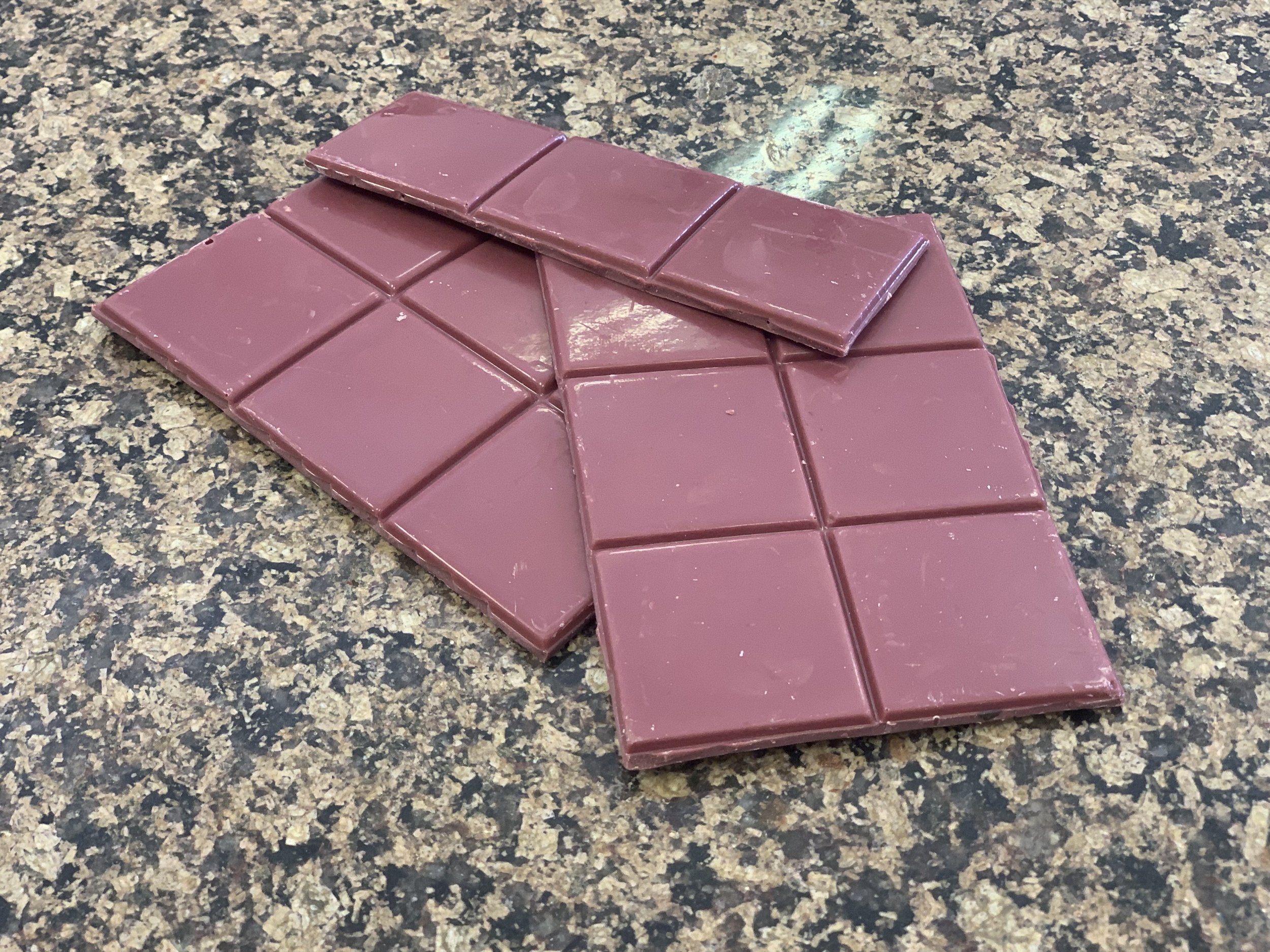
A day later, after following the recipe proportions above I was rewarded by Lemon Lime Ruby Chocolate
Continuing to FAFO, I wanted to see if I could bring the amount of juice down from the 80:100 ratio. The next batch I did was 80 g of nibs and 80 g of lime juice. It still didn’t change color for 12 hours or so but it did change color and this time soaked up all the liquid.
Seeing if I could push the envelope I reduced the lime juice yet again to a 3:2 ratio (100 g nibs and 66 g lime) and waited 12 hours. This time the color had changed but it was not nearly as vibrant and there were still overtones of brown.
So there you go, you can indeed use citrus juice, either lemon or lime, to make Ruby chocolate. I’d suggest 1:1 ratio but maybe you can get away with a little less juice. Or you might need a little more. Nature doesn’t standardize how much citric acid is in various juices. YMMV.
And lest I forget possibly the most exciting part, I found this new natural Ruby chocolate WAY more approachable. I’m the first to admit that 10% citric acid delivers quite the tang. Here the tang is wholly absent and even the lemon and lime flavors are gone. You end up with a pretty simple, slightly fruity ruby milk chocolate.
Summary
First Attempt
Nibs: 80g
Juice (Lemon/Lime): 100g
Results:
Nibs very wet with no immediate color change
Color changed after overnight soaking
Dehydrated and ground: mild ruby chocolate flavor, mellow and fruity rather than overly tangy
Second Attempt
Nibs: 80g
Juice: 80g
Results:
No color change for 12 hours—eventually changed
Liquid fully absorbed
Dehydrated and ground: mild ruby chocolate flavor, mellow and fruity rather than overly tangy
Third Attempt
Nibs: 100g
Juice: 66g
Results:
Color changed after 12 hours, but less vibrant
Some brown overtones remained
Key Takeaways:
Approximate 1:1 nibs to juice ratio produces a mild ruby chocolate; adjust juice for more vibrancy.
Tanginess is reduced compared to citric acid—juicier, friendlier, and less harsh flavor profile.
Your results may vary based on the acidity of the juice; each fruit is different.
That is all I have for now other than encouraging you to FAFO and getting some Lavados nibs before they are gone. We are running low.
Also
In the coming weeks I’m planning on releasing a new mini series where I attempt to sweep away some of the clutter that has accumulated over the years in regards to each step of the process. We’ll be simplifying as it were by drilling down to what is important and what is myth, habit and/or misinformation. I touch on such things as:
How much to sort your cocoa beans?
Will 10 seconds or 2 F make a difference in roasting?
25.1 or 25.3% sugar?
What’s important when adding ingredients to the melanger?
Tempering in a 68 vs 72 F room.
Storing your chocolate.
And certainly much more. If you have a fine detail that you are curious about and if it is important, submit it in ASK?
