
Recipes - Resolving Complexity Part 2
Before todays Act opens I want to let everyone know there are still openings in our three upcoming Chocolate Making classes. Chocolate Making 101, Chocolate Tempering 102 and the next level up, Chocolate Making Workshop 2.
Act 2
Welcome back my friends. I’m so glad to see you. Please get some refreshments and something warm. The fire is going well but there is a chill in the air, isn’t there?
Good, good, good. Everyone has what they need? Very nice. I see some of you brought along chocolate. We’ll get to that in a bit.
I really wanted to jump right into how to create a recipe. Instead it seems I am compelled to tell you a couple stories. In so many traditions lessons are taught through story so I’m going to follow that well worn path to cover some basics. You need some understanding of what you are working with so that when you come up with a question you have a bit of a chance of answering the question yourself. Without that you are following instructions blind and you’ll probably be guessing as to what is going wrong when something inevitably does go wrong.
The Basics
Some 20 Years ago, when I had barely worked out how to make chocolate at home , I had a great visit with Frederick Shilling, The Founding Alchemist over at Dagoba Chocolate. Our visit, sans the fire, was not too different than this. We sat around for a bit, him giving me some basic tips and us just chatting. Somewhere along the line he mentioned there were really no rules in chocolate making. You’ll be hearing me say something along those lines tonight. I and my pedantic brain chimed in that you couldn’t add water to chocolate. His response really gave me pause. He said that didn’t count as everyone knew you couldn’t do that. There is nuance there. He was both right and wrong.
Have you heard that you can jump out of an airplane without a parachute? You really can.... but only once.
Did you know you can eat any mushroom you find in the woods? You really can...but sometimes only once.
You can absolutely add water to chocolate....but only once. After that it is no longer chocolate.
What Frederick was absolutely correct about is that you cannot make chocolate with water. Does anyone know why? No? That’s cool.
The simple answer is chocolate is just a definition. Chocolate is a suspension that does not have any water in it. Cocoa and sugar particles are suspended in a matrix of cocoa butter. As long you meet these requirements then it is chocolate. It does not even have to be smooth. There is coarse Mexican chocolate after all that kickstarted Chocolate Alchemy. That’s a story for another time. Technically you can have cocoa liquor that is 100% chocolate with no sugar so even sugar is a soft requirement but since I’m talking about sweet and smooth modern eating chocolate lets require sugar as well.
Some years ago I was at a friend’s house and they were making dinner and running into issues with a soup they were trying to thicken. It was clumping up but not thickening. They explained sometimes it worked and sometimes it didn’t. They had no idea why they were adding flour or cornstarch. All they knew was if you add one of those it would thicken the soup or gravy. Sometimes they sprinkled one or the other on top, sometimes they mixed it into the meat or vegetables they were sauteing. They told me they tried stirring them into water and again sometimes it worked and sometimes it clumped. They were totally baffled.
I asked them if it worked when they mixed the flour into anything sauteed. Yep.
If the flour was sprinkled onto the top of a soup that happened to have floating fat it also worked, but not if it was cornstarch.
Flour stirred into water and poured in it clumped or at least didn’t thicken but it worked fine if it were cornstarch.
They were amazed I could predict their failures and successes. I see some heads nodding. You know what’s going on don’t you? For those of you that don’t it is something you learn early on if you are taught cooking formally. Both flour and cornstarch have to be dispersed in a liquid so it can distribute evenly, but it has to be oil for flour and water for cornstarch. They were mixing them pretty much randomly but just a little formal education would have saved them years of frustration. It is kind of a complex idea and there is a bit of science behind it but the simple rule I just gave makes thing work nearly all the time.
That is why I’m going to give you some basics. I don’t want you having years of frustration. So bear with me as we go over some basics that cooks and chefs who have been formally trained know and don’t even think about but can bite you in the ass if you don’t know about them.
If you don’t mix flour into oil then water will surround clumps of the flour and form a gel preventing further water from getting in. In other words you form a clump of flour.
All that leads up to the more complex answer to why chocolate can’t have water in it. As a suspension, the cocoa particles are encased in oil and basically floating freely around and the chocolate flows nice and smooth. If water goes in then it gets attracted to cocoa particles. The science behind that is that cocoa and water have slight charges, like micro magnets if you would. What ends up happening is the water molecules start linking up sort of forming microscopic threads and structures...just like when flour is added to a soup the correct way. They both form a gel. You basically make chocolate gravy. As good as it might be, it just ain’t chocolate any more.
This is why there is the no water rule in chocolate. Now you have an inkling why I hope.
Types of Chocolate and Recipes
Let’s get into recipes now, what is important and what isn’t.
There is only one holy commandment in chocolate.
Thou shalt be no water in chocolate.
There are 3 basic types of chocolate; Dark, milk and white.
For our purposes if it does not contain milk or a milk substitute, basically nibs and sugar, then it is a dark chocolate.
If it has nibs and contains milk or a sub then it is a milk chocolate.
If it doesn’t have any cocoa nibs then it is white chocolate.
For the time being don’t fret over if you would call a 65% chocolate dark or semi-sweet. It’s all just a continuum. Likewise, don’t concern yourself the difference between a classic milk chocolate and a dark milk chocolate. Nothing is regulated so everyone is going to have a different take on it.
Percentages in Chocolate (like 70%) refer to the total of ALL cocoa in the chocolate—including cocoa butter. One 65% chocolate can have 50% cocoa nibs and 15% cocoa butter and another can be 60% cocoa nibs and 5% cocoa butter.
How much cocoa butter do you need to add? The most important thing is to make sure there is enough total cocoa butter so the melanger doesn’t bind up. The minimum is about 35% and from a taste perspective you don’t need to go over 45%.
Cocoa beans are about 50% cocoa butter and you have to take that into account.
A simple 80% dark chocolate will be 80% cocoa nibs and 20% sugar. That means there is 40% cocoa butter and you are in the golden zone.
Keeping it that simple for a 60% dark chocolate doesn’t quite work as 50% of 60% is 30% and that is going to have trouble in the melanger. For that recipe you need a little bit of cocoa butter. Working out how much isn’t rocket science. You mostly have to recognize as you add cocoa butter you have to take away cocoa nibs, assuming that 60% chocolate. I like to just add twice the amount of cocoa butter that I’m shy of the minimum. Since we are 5% short of the 35% minimum, at 10% cocoa butter and reduce the cocoa nibs by 10% to 50%. We now have 25% cocoa butter from the nibs plus the 10% we just added and we are spot on the 35% minimum.
Of course you can add more if you want. I would not add more than 20% extra butter in a dark chocolate recipe or its probably going to start tasting kind of thin. But it also won’t hurt it in the least.
As for sugar, every day sugar is all you need. Don’t be tempted to use powdered sugar as it contains anti-caking agents like cornstarch and that does funny things to the texture of your chocolate. Anything that isn’t white sugar is ok as long as it is bone dry. That would be like demerara. If you want to get fancy with something a bit damp like brown sugar just put it in the oven on low until it is all dry.
That’s dark chocolate in a nutshell.
To make milk chocolate you have to add milk powder. I like whole milk powder instead of non-fat. A good range is 15% to 25%. There are no milk chocolate police so venture out of that range at your own peril.
A really easy milk chocolate recipe is just 25% of the 4 ingredients.
White chocolate is nothing more than roughly equal parts of cocoa butter, sugar and milk powder.
On making that chocolate bar you love
Now it caught my eye that one of you has a bar of Lindt milk chocolate. I’m guessing you want to know how to make that? Don’t look embarrassed. That’s a nice chocolate. I freaking love milk chocolate and we are all here because we love chocolate. There ain’t no chocolate shaming going to be tolerated around these here parts. I’ve got to tell you nothing quite chaffs my ass more than people start trying to one up one another with how dark they like their chocolate. It’s so often this huge dick swinging contest. I got no patience for it. I did see a video the other day from Bournville that made me laugh. Hilarious member swinging at its best.
‘Dark chocolate isn’t meant to be enjoyed, it is to be endured’. Yeah, duck that. Whew, sorry about that. Like I said, no chocolate shaming here. You eat and enjoy what brings you joy. That goes for all of this. If you aren’t having fun, you probably aren’t doing it right. It is also ok to like 98.9% dark chocolate if that is your jam. I LOVE hot peppers. Like serious Reaper and Pepper X hot peppers. I gave up long ago competing with others for who could eat the hottest food. It got tiresome. Don’t be that guy swinging it around. Don’t be tiresome. Now I just eat them and enjoy them and that is that.
Alright, back to that Lindt bar. This is honestly a little beyond the basics but I get it asked all the time by new makers so it is worth chatting about. There is no other way around looking at the label and doing some maths.
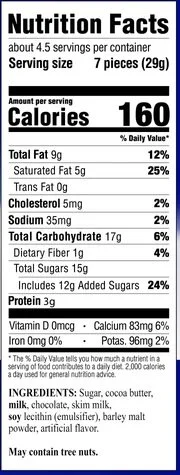
I could do this rigorously with a bunch of algebra equations that would make your high school math teacher proud but it just isn’t worth it. Instead we’ll just pull out the numbers we need to get a basic recipe. There are 15 g of added sugar in a 29 g piece. 15 divided by 29 is 0.517 or 51.7% sugar. That’s the easy part. After that we have to do a little sleuthing since there is a little of everything in the remaining ingredients. Because labels list ingredients in quantity order we can see cocoa butter is next. 9 g out of 29 g or 31%. The FDA says milk chocolate can’t have less than 10% cocoa in it so let’s say that is how much is there. That means 21% cocoa butter. That gives up this.
51.7% sugar, 21% cocoa butter, 10% cocoa and the rest is milk. That would mean 17.3% milk. That matches the order on the label and is a fine place to start.
I could drone on about the other things listed in the label (malt, lecithin, etc.) but I want you to ask yourself why you want to make what you can buy given this next fact from me. Whatever you make isn’t going to taste like what you can buy. Even if we had the exact proportion of ingredients that chocolate has, the chocolate you make is going to taste different. Their ingredients are different. We can’t even hazard a guess at what type of nibs they use and they used totally different equipment. That doesn’t mean theirs is better, it is just different.
At the end of the day we are making the Bob Ross version of chocolate. We are making some happy little chocolate and if the percentages are different from the commercial chocolate we can just call them happy little accidents and love the chocolate for itself.
Bob never tried to paint a Rembrandt or even a Thomas Kincaid. He painted pictures that made him happy and tried to show you how you could too. He never made the perfect painting as you will never make the perfect chocolate. You’ll make chocolate and strive to make chocolate that makes you happy and when it isn’t to your likely you learn from it and make a new chocolate painting.
I can’t stress enough you should follow your own inner Bob Ross. Play with your ingredients. Don’t worry about failure, just treat them has happy accidents and don’t stress about one percent here or there. You won’t be able to tell 27% sugar vs 28% sugar. Either is fine.
Bringing it home
Let’s wrap this up with a few things I have not mentioned and then a little summary.
When deciding if I like a particular cocoa bean I use a standard recipe. My go to is 70% cocoa nibs, 5% cocoa butter and 25% sugar. I recommend you do the same. If you think you have a favorite sweetness level by all means start there. It’s even ok to to go with a milk chocolate if that is your fancy.
Whether you love dark or milk chocolates, virtually any cocoa from any country can be used. It is all personal preference.
You can add various flavored oils and extracts to chocolate. Just verify none contain alcohol as water always comes along. Oil only.
In summary,
Thou shall not use water, not even a drop
Dark chocolate is cocoa nibs and sugar
Milk chocolate is just dark chocolate with milk powder
White chocolate is milk chocolate without cocoa nibs
All chocolates need 35-45% fat
Any cocoa bean can be used to make any chocolate type.
That is all I have for this evening. I really appreciate you all coming and please come back. I am going to talk about roasting and making cocoa nibs next time. In the mean time, embrace your inner Bob Ross and remember if you are not having fun and enjoying your chocolate you might not be doing it right. Bob certainly was always having fun, especially when he made happy little accidents.
