
Ask the Alchemist #339

Can you please help me. I purchased Behmor 2020SR roaster, not modified yet. I want to roast Dominican beans at 120C or 260F for 25 min. Which setting would you recommend to use? When I roast on P1 the temperature in the roaster goes over 400F, the temperature of beans reached over 140C, I also tried P4 and the temperature in the roaster reached 399F, the beans temperature reading was 114c
The reason why I want to roast at 260F for 25 min it’s because that roast profile gave me the best flavour notes in my previous drum roaster which I replaced with Behmor.
Help, I’m caught in a Schrodinger superposition.
I both dislike and love these kind of questions
I want to answer it simply and also go all quantum state hyper complex.
I want to rant and I want to be helpful.
I want to be calm and I want to yell.
I’m so conflicted. Help me obi-wan, you’re my only hope.
Ok, maybe I’m a little punchy too.
Let’s see what some free flowing stream of consciousness does for us in the vortex of superposition (pst, I’m just tossing word salad around).
I’m puzzled why you would try to roast at one temperature in the Behmor when not one shred of evidence or documentation points to it being able to roast that way. Ovens roast (mostly) at one temperature, not roasters.
You mention moving from another drum roaster but for some reason you moved away from it. It could be as simple as it not being yours and you lost access to it but it reminds me of some people reaching out to me because they hated a certain ‘roaster’ they were using and wanted advice. I’m not going to name the company as I don’t (cocoa) want to give them any more attention (town) but suffice to say it was NOT a roaster. It was an oven that they put a drum into and the only control it had was a standard single point oven thermostat. That sounds a lot like the device here that was moved away from.
And I get it might sound like a roaster but it isn’t in the sense that it is a roaster with a serious design flaw.
From a control perspective, a good roaster should work a lot like a car. You need a way to speed up and slow down, a way to see how fast you are going and how hard you are pushing the engine. That is of course the gas pedal, the brake, the speedometer and tachometer. Subtly, you also need the ability to easily go different speeds.
The roaster from they who shall not be named has none of these.
It has one control, a thermostat. In a car this would be akin to some type of governor or cruise control. You tell it what the maximum speed is and it it puts the pedal to the metal until it reaches that speed and then coasts until the speed drops below the maximum speed then it is pedal to the metal again.
Wouldn’t that be a GREAT way to drive a car? Yeah, no.
The only way to go a different speed is to change the set point. And what happens if you are going too fast and need to slow down (not that you know how fast you are going of course)? Since you have not been given a brake and you can’t adjust how much gas you are applying you pretty much are resigned to coasting by either turning the thermostat way down or opening the roaster door.
I say again, wouldn’t that be a GREAT way to drive a car? Yeah, no.
This in a nutshell is why I pretty much hate roasting in ovens and that abomination above. Why in the world do you want to roast cocoa that way?
You asked what setting would you use? None. That is not how the Behmor works, full stop. That is not how any good roaster works. Why would you strip the few controls you have in your Behmor out, because that is what you are asking to do.
To be clear, the Behmor is not a perfect roaster but for the price point it is better than that thing above.
You can apply different amounts of energy (gas) in the manual mode. It isn’t control infinite like a gas pedal but you can set it to 0, 25%, 50%, 75% and 100% power.
It does not have a brake but it does have a draw fan that constantly strips some energy way and you can turn down the power input (see above). In 10 years roasting on one I’ve not found the need for finer controls. And yeah, you can open the door.
Out of the box, the Behmor 2000 does not have a way to see how fast you are going. That sucks. Some time ago I worked out a pretty simple way to install a thermometer in the bean mass (How to Modify your Behmor)** and that allows you to work out how fast the roast is going and what point (temperature) you are in the roast.
**Look out in the coming weeks, we are going to be offering this service so you can buy a modified Behmor
Does that start to explain why am I making a big deal about control and profiles? Hrm, I guess I should define for you new folks (hi new folk) what a profile is and what a profile isn’t.
Roasting profiles are temperature vs time relationships of the beans. They don’t care about what you are roasting in or how much you are roasting.
In car speak they say “accelerate over 10 minutes until you are going 20 mph, then back off the gas and accelerate over 3 minutes until you are going 23 mph, now back off a little more and get to 26 mph over 6 minutes, then stop the car.
In graph form that looks like this.

It describes the speed (mph) vs the time. Does that look familiar at all? It should. Have a look at this coffee roasting profile.
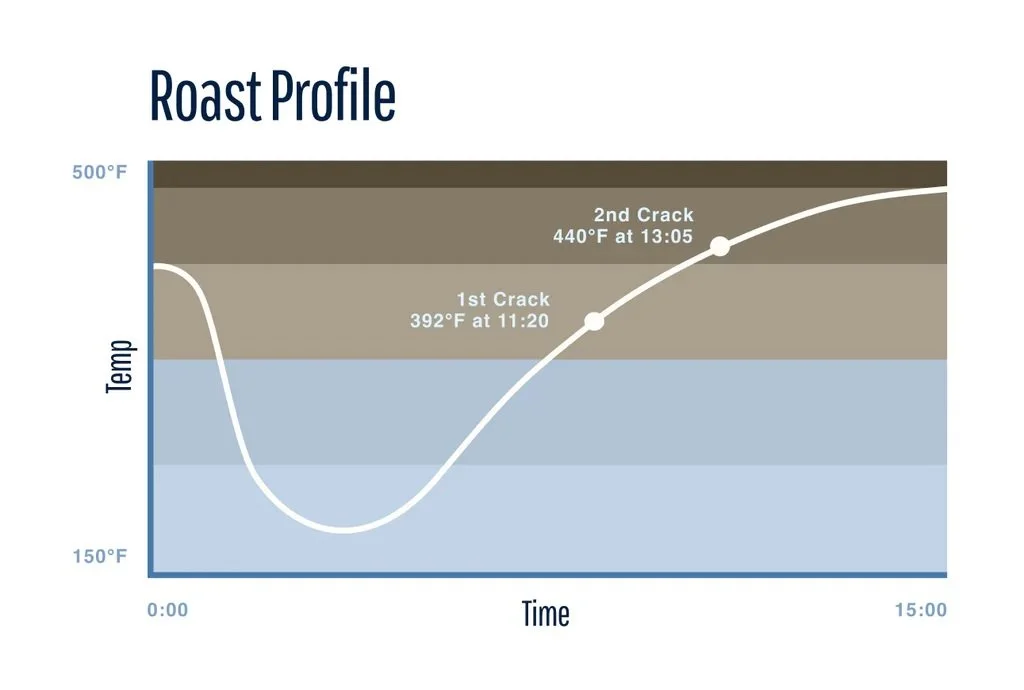
It describes the temperature of the coffee bean vs the time it took to get there.
And if you poke around the site here you’ll find cocoa roasting profiles that look strikingly familiar.
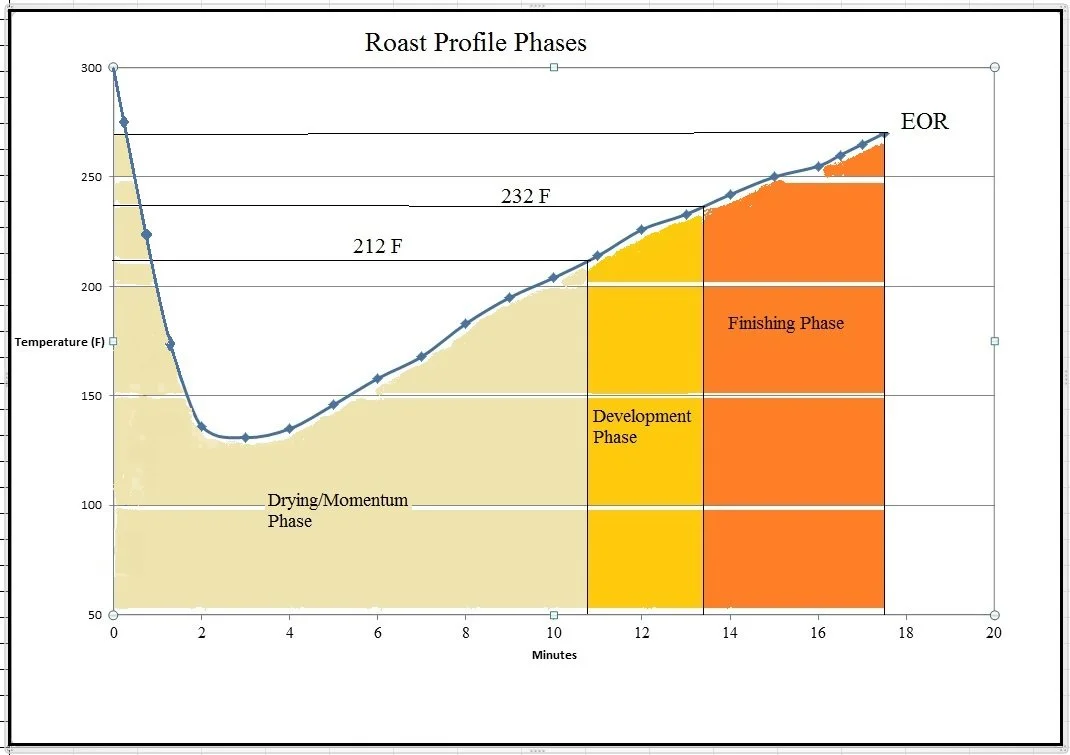
It is the same thing, temperature vs time. That is the hallmark of a roasting profile. Nowhere does it say anything about the temperature of the oven, roast chamber or surrounding air.
You are having issues because what you used before were baking directions, not a profile. It is what you would see in a brownie recipe. Bake 30 minutes at 350 F.
Why is that important and why am I harping on it?
Let me give you an example or two:
You have a lovely batch of brownie batter. You set your oven to 350 F and pop it in for 25 minutes and out comes the best batch of brownies ever. You have your profile. 350 F for 25 minutes. Bam, you’re killing it. You are going to share with all your friends so you make a triple batch.
350 F check. 25 minutes check. You pull it out....and it is a gooey underdone hot mess. What in the world happen? You used the same profile!!
I think you see. You had way more batter in there so it under cooked, plain and simple. The issue was not a faulty profile but that you were not using a profile at all. You were using baking directions for a certain amount of batter.
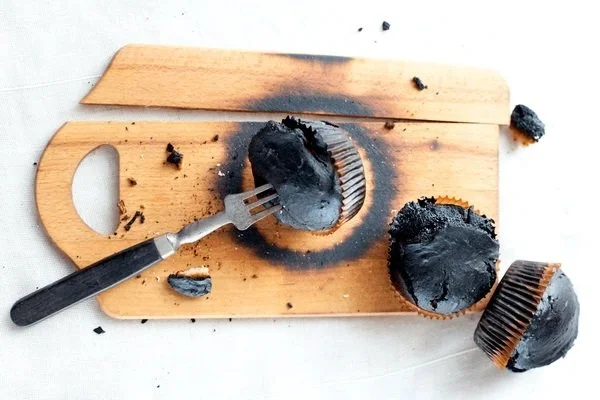
Just imagine if you had cut the recipe in half and put them in little cupcake containers. You would have ended up with little black cakes of pain and sadness. You most certainly don’t want cups of pain and sadness.
The same thing happens when cooking a hunk of meat on the grill. One time and one temperature will never work for all thicknesses and weights of steak. 450 F for 15 minutes might work just great for a 2” thick 24 oz slab of meaty goodness bringing the center temperature to a succulent 122 F but you toss on a 3/4” 8 oz petite sirloin and it is going to be a chewy if not burned culinary disaster after 15 minutes. Yet more pain and sadness.
The proper ‘profile’ is to toss the meat on the hot iron with a thermometer inserted and cook until you reach 122 F.
That is a basic profile as you are describing the end point of the steak, not just a couple conditions (temperature and time) while leaving out how much you are cooking.
The reason why I want to roast at 260F for 25 min it’s because that roast profile gave me the best flavour notes in my previous drum roaster which I replaced with Behmor.
All this is by way of saying that you don’t know what your profile was since 260 F for 25 minutes isn’t a profile and without that you are flying blind in the Behmor or any other roaster.
I had wanted to try and make some estimates and extrapolate what your profile might have been but with two major variables I have no way to do that. About all I can say is your final temperature was somewhere below 260 F because if that was your oven temperature than the beans can’t get over that. It is just physics. Based upon how I give my oven roasting recommendations (setting the oven temperature to about 15 F above your target end temperature and coast in) and how woefully underpowered the not-roaster that shall not be named is, I can only make a couple semi-educated guesses as to the final temperature.
Without knowing how much you were roasting it becomes impossible as you saw in the brownie example. At most I would guess 245 F and maybe only in the upper 230s F which is a very light roast. I’m honestly surprised it had good flavor. Then again, you said best, not good. Many roasts in that rotating thing just make chocolate of pain and sadness or boring chocolate at best….and I guess best is better than boring.

What I would recommend you do is starting over with the Behmor and develop a real profile. Modify your Behmor for a thermocouple or use our upcoming service to have it done. Read Ask the Alchemist 200-206 about profile roasting and take your roasting and chocolate to the next level.
And would you look at that. You have read to the end and in doing so I have been observed. Having been observed I have collapsed from my helpful/asshat alchemical superposition into just one state. It would appear I am now in the Friendly and Zen Alchemist State.
Thank you. I like this State.
