
Ask the Alchemist #336
Level: Novice
Read time: 7 minutes
I love all your content. I can’t seem to find an answer to this. Can I add coffee beans to chocolate? How long should I roast them?
I hope this new year is finding you in good stead. We have been doing a number of site updates and I know we have a lot of information. We have started the huge task of attempting to wrangle it into submission. It is not unlike trying to wrestle an oiled octopus.
We have a new section called Resources on the home page. Start there.
In there you’ll find our basic chocolate making guide and in there you’ll find this:
Other ingredients:
As long as it does not contain water, many ingredients can be added to chocolate anywhere in the 1-20% range.
Coffee
Spices
Herbs
Nuts
Fruit powders
Essential oils
If the ingredient contains an oil, like nuts, you can include that percentage in your total minimum fat needed (35 - 40%) but testing is recommended. Not all oils play well with cocoa butter and might make your chocolate behave oddly. In particular, coconut oil inhibits tempering and makes the chocolate extra fluid and difficult to harden.
In nearly all cases I suggest you do small test and methodically experiment before ruining a whole batch of chocolate.
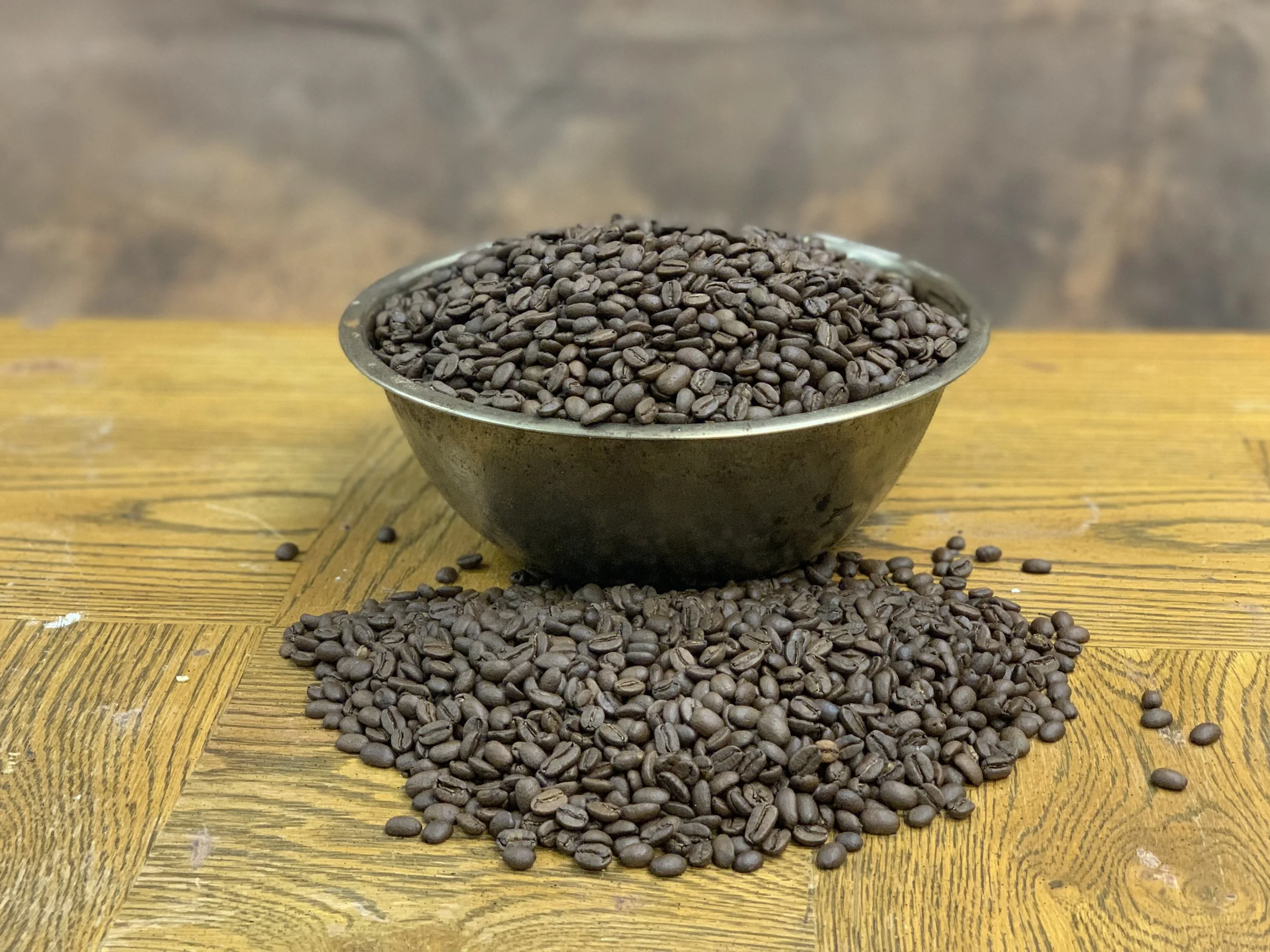
Coffee is right there at the start of the list. So, yeah, you can add coffee. It is helpful to give it a rough grind before putting it into the melanger. The beans are just large enough and round enough they have a tendency to stop the rollers. The range I give above is 1-20% as a general measure.
I’ve experimented with coffee chocolate on and off over the years and to my tastes, 3-5% seems to be a real sweet spot.
How long should I roast them?
Well now, that is a can or worms.
It is kind of an open secret that although chocolate is my business, it is not, contrary to how it might look, my absolute passion. Don’t get me wrong, I like chocolate but I LOVE coffee. I mean, I’m kind of obsessed with coffee. One might even call me a Coffee Geek and Home Barista. If it were not for coffee, Chocolate Alchemy simply would not exist.
It is time for a story.
Grab your cup of coffee and pull up a chair. Go on, I’ll wait. Better yet, I’m going to go make myself a Kumo. You can read about them while I’m gone.
`
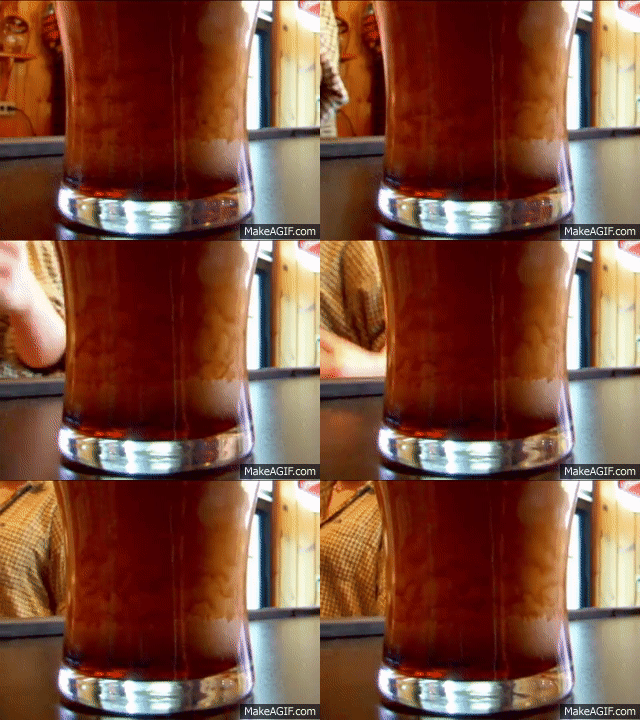
What is a Kumo? It is the most delectable of coffee drinks. I drink every them every morning and I invented it. It is debatable whether I was the first to invent it (I think I was) but it hardly matters. It brings me joy. In Japanese kumo means cloud and a Kumo is light, foamy, coffee goodness. I’ve given it to more than one person who declared they did not like black coffee and had to change their mind after the Kumo experience. If you want to give it a try you are going to need freshly roasted coffee, an pretty good espresso maker, ice and the ability to steam the drink.
The other thing I love is it
cascades like a fine pint of Guinness
Freshly grind about 18 grams of freshly roasted coffee and pull a double espresso only ice. Optimally you’ll get 1.5-2.0 oz in 28-36 seconds. Pulling the shot onto ice is critical. By doing so you instantly lock in a bunch of flavor just like the Japanese iced coffee method. Once that is done, you then steam and foam it hot. The result is hot, smooth and rich.

Ok, I’m back with my cloud of coffee. Let’s continue.
I moved to Oregon in 1999 and found pretty quickly that I was struggling to find coffee I liked. I instantly knew I could not stomach Charbucks and Reeks and even the not so burned brethren in the local market still just didn’t suit my tastes. I could get by with a couple sugars and 1/3 milk but I didn’t love it. That Christmas my partner bought me a FreshRoast coffee roaster. It was cute and fun enough and could roast about 3 oz of coffee at a time. I fondly and with chagrin remember commenting that although I liked it I just could not see myself roasting fresh coffee every week. That lasted about a week and then I was SO VERY HOOKED.
I moved from the FreshRoast to scouring the thrift stores for the coveted West Bend Poppery popcorn popper, the near holy grail of DIY home coffee roasters. I learned to disable the bimetal thermostat (after learning what a bimetal thermostat was) so it would get hot enough to roast coffee. I expanded the air inlets so it could move more air. I split wired the controls for the heater and the fan and put the whole thing on a tilt mechanism so I could keep the beans from jumping out. Of course I had to insert a thermometer into the chamber and secure a glass chimney extension so I could tell what was going on.
Naw, I could never see myself roasting coffee every week. LOL.
I pretty quickly learned that roasting coffee was not just turning green beans into brown beans. I learned about the drying phase, the straw stage, first crack, second crack and even the dreaded third crack (pst, that means the beans caught on fire!!). I learned roasting too long could lead to flat tasting beans and roasting too fast could scorch the beans. I learned that moving too slow through a given stage could rob you of flavor but moving too fast in another stage could make your coffee too acidic. I learned how you moved through these different stages mattered a lot and when you talked about how you roasted and went through these stages you were talking about a roasting profile.
Sounding a little familiar? Yeah, if it were not for coffee, Chocolate Alchemy would not exist and I would not have written so much about Profile Roasting.
I learned that the length of the roast hardly mattered or more specifically, it didn’t matter as any useful descriptor of how to roast coffee and get good flavor (See OG question as to why I’m mentioning this).
How long should you roast? See why I can’t answer that? I can’t answer that any more, and really even less so, that I can answer ‘what temperature should I roast my cocoa at?’.
Just like cocoa, different origins of coffee have different flavors and many of them favor one roasting profile over another. Add to that you can drum roast and air roast coffee but you really can’t oven roast coffee unless you are fan of billowing thick smoke. 0/10, would not recommend oven roasting. So asking how long you should roast coffee tells me (said respectfully) you don’t know enough about roasting coffee to currently attempt it. You can certainly learn but that isn’t a lesson I want to get into. It is a deeper well than cocoa roasting.
Instead you should check out Sweet Marias and those coffee links above. Dive in, it is a blast. And if it doesn’t happen to be your thing (that’s cool, no judgement) just buy some freshly roasted beans at a local market. Coffee tends to last 1-2 weeks, says the coffee snob. If you are not sure of the roast date, pass it by. Stale coffee isn’t worth your time in my very not humble opinion. Just get some expertly roasted coffee from, you guessed it, Sweet Marias.
A couple other things, since we are talking about coffee and chocolate. I find the roast level for coffee for drinking is highly varied and you’ll find a bunch of terms like City, Full City and French. Where those terms tend to some some level of agreement of meaning, you’ll also find Light, Medium and Dark and those may seem obvious but I’m here to tell you they are not. What I call the heavy side of medium (I also call it Full City to Full City + or taking the roast just to the edge of 2nd crack), many people will call dark roasted and charbuck lovers would consider under roasted. Going the other direction, there is this abomination...sorry, style of roasting called Third way that is uber light. To Third wave lovers they say you can taste the origin and varietal flavor. I say you can taste the grass the growers had to walk through to pick the coffee. It is generally bright and acidic and doesn’t taste much like coffee. And as they say, a picture is worth a thousand words.

Sorry, not sorry, I told you I am a coffee geek. I saying all this to say I recommend either you get a coffee you like drinking and if you don’t know what that is, get something in the City+ to Full City+ range. That means a solid mahogany color and no oil showing. No light brown, not charcoal black. In the range I gave you it is going to taste like coffee, which I can only assume is your goal. You may or many not have any origin character but given how little you are going to be using (3-6%) varietal and origin flavor are just not going to be able to compete and show through the cocoa flavor. What will come through if you decide not to heed my advice are bright acidic flavor and burned flavors.
With that in hand, now you can make some coffee chocolate. In my years experimenting I’ve found milk goes really well in a coffee chocolate. I’ve made it without, in the 4-5% range and although good, it lacked something. A little milk powder goes a long way. The general range for milk is 10-20%. For a coffee chocolate 5-10% is good without distracting from the coffee. That said, you can go full tilt the other way and make an utterly delightful latte chocolate. Take one of our 35% milk chocolate kits and add 5% coffee to it and Bob’s your uncle. I’ve found when you get above about 7-8% coffee, no matter the coffee, no matter the roast, a less than great bitterness starts creeping in that cuts through however much sugar you have put in.
And one more thing. Every December my daughter and I make truffles for the holidays. One of the flavors this year was coffee truffles. In all honesty, I can’t tell you the chocolate recipe we used for the base of the truffles other than it was coffee. In this case I was definitely NOT doing science, I was just Ducking around and didn’t write anything down. It had 2-3 different 75% chocolates in there that I tasted and thought were good enough. I added some sugar (10%???), some more cocoa butter (5-10%) and a touch of both whole milk powder and 2% cream (that one I measured because I didn’t want too much). Oh, and 3.0% coffee (Ethiopia DP Korate if you must know, roasted 9:45 to 1st crack, 11:55 to just shy of 2nd crack at 442 F, rested 5 days). The next day I came back, tasted it and added a titch more sugar, 5% more cocoa butter and another half percent of coffee.
It was so good. I discovered the chocolate last week and it was better than I remembered. It inspired me to see if I could get close to offering it to you...so I am.
January Chocolate Making Kit of The Month
This month’s Kit of the Month is going to be a 60% coffee milk chocolate made with Ivory coast cocoa. This is one of those times I’m giving everyone the recipe just because I want to share the love.
450 g roasted Ivory coast nibs
150 g cocoa butter
300 g sugar
70 g whole milk powder
30 g Sweet Maria’s Peru Jaen Alianza Mikan coffee, roasted 10:30 1st, 12:35 @ 444 F
That said, the only way to get the coffee I roasted for it is to buy the kit. I’m a sneaky bastard, I know.
I love you all too. I really do.
There you go. Yes, you can and should add coffee to your chocolate. If you don’t already roast coffee, maybe this is your time to learn how.
As always, be good to each other out there. We are all just trying to get by.
Until next time, Ciao!
